To-do app for ADHD
A to-do app for ADHD that shows one next thing
Sequence is a to-do app for people with ADHD and the households they live in. Instead of a long list, it shows one Up Next card. There are no red overdue badges and no streaks. Each person gets a color lane, shared jobs go in a green Together lane, and the whole house can see it on a TV.
No credit card · $6/mo or $59/yr per household · US & Canada
Updated October 2026
Why most to-do apps don't work for ADHD brains
A regular to-do list assumes the hard part is remembering. For many people with ADHD, remembering is not the bottleneck. Starting is. A screen of forty items asks the brain to choose, rank, and commit before anything gets done. That choice can stall the whole morning.
Red overdue badges and streaks add a second problem. A slipped task turns into a score you failed. The list becomes a record of what went wrong, not a place to pick up again. For many people with ADHD, that shame loop is enough to close the app.
Setup becomes another chore. Filters, projects, timers, and “systems” ask you to build the plan before you can use it. Sequence keeps the pile and shows one card. Sequence is a productivity tool, not a treatment.
One Up Next card instead of a list
The loop is small on purpose. You add the household’s tasks. Sequence keeps all of them. What it shows is one Up Next card — the one thing to do now. Finish that card and the next one comes up. You do not have to re-rank the pile every time you open the app.
That is the whole product promise: one next thing, then the next, in the order the household already chose. The rest of the list is still there when you need it. It is just not the first thing you see.
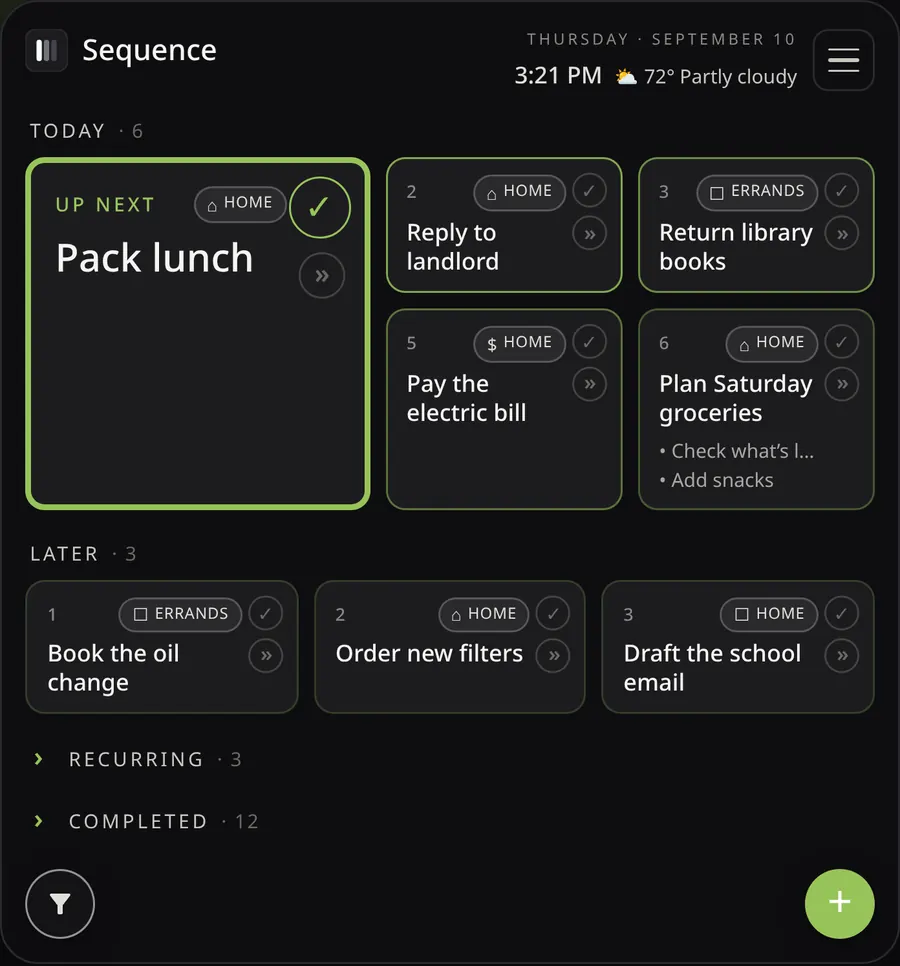
No red overdue badges. No streaks.
Sequence does not mark you late in red. It does not keep a streak you can break. A task that does not happen today is still a task. It stays in the sequence. When you come back, Up Next is waiting.
This is a design choice, not a slogan. The usual productivity stack uses overdue states and streaks as motivation. For many people with ADHD, those signals read as a scolding. Sequence refuses them so the board stays a place you can open on a hard day.
There is no public score, no “days in a row,” and no angry color when a chore slips. The household still sees the work. Nobody is ranked for doing it.
Built for the whole household
ADHD does not live in one phone. Partners, kids, and roommates share the bins, the lunch, and the landlord text. Sequence gives each household member a color lane so you can glance at the board and know whose work you are looking at.
Shared jobs go in a green Together lane — work that belongs to more than one person, visible to everyone on the same plan. One price covers the household. There is no per-person charge and no seat counting. You are not buying a personal inbox and then bolting people on later.
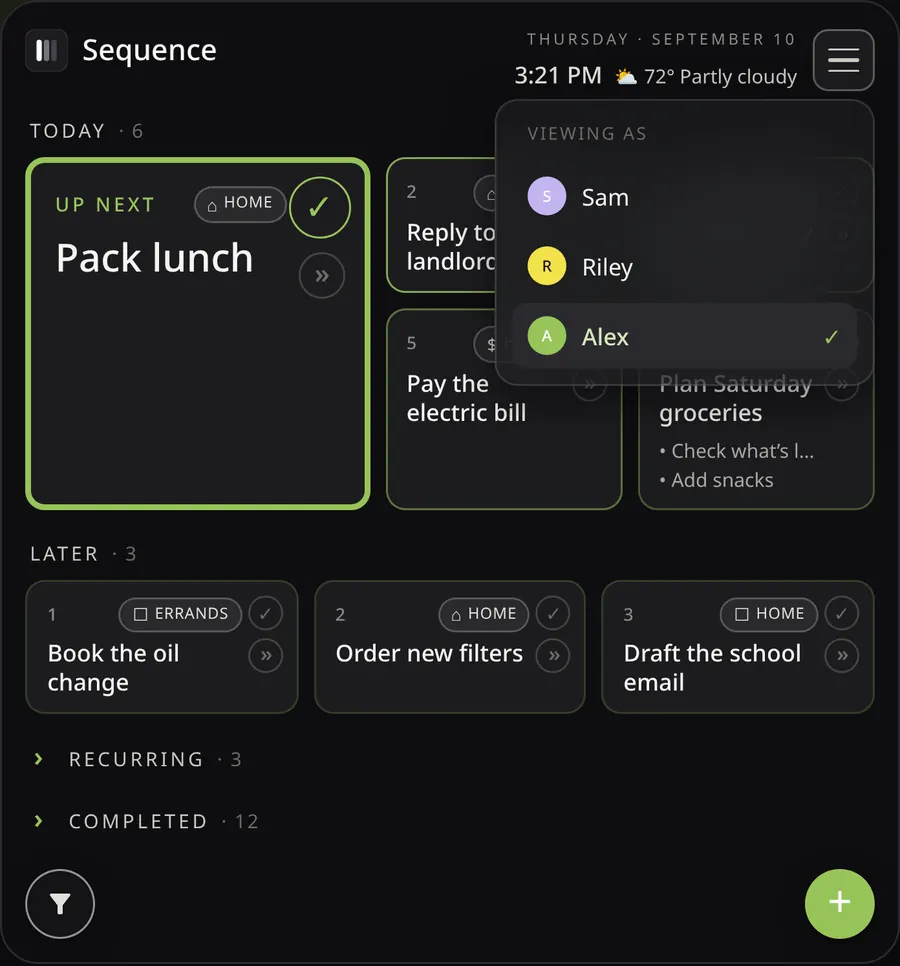
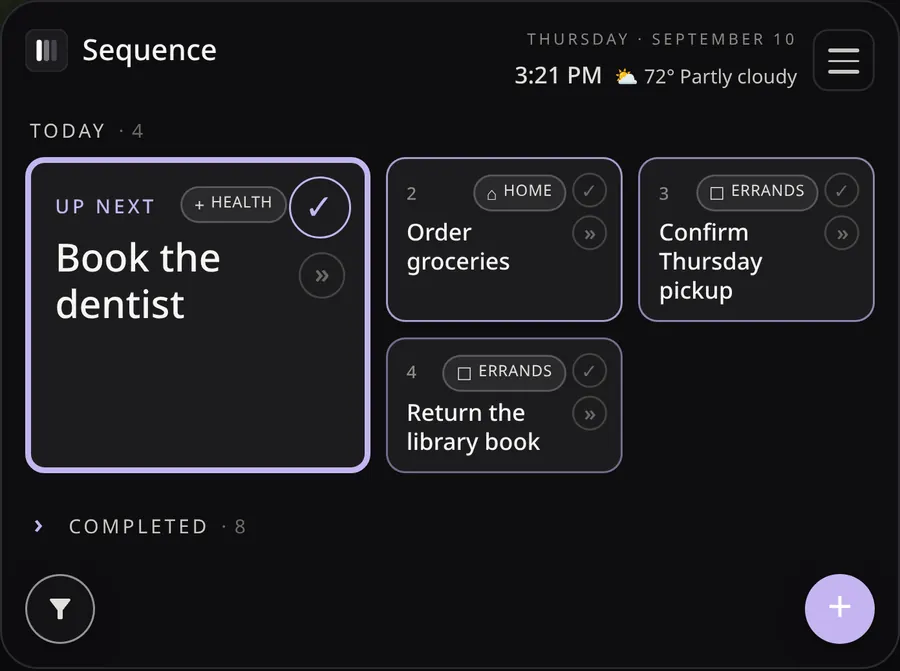
A TV or wall display the whole house can see
Sequence has a household TV display. Cast the board to a TV or put a tablet on the wall when you want a shared brain in the kitchen. It is glanceable on purpose: names, colors, and Up Next — not a countdown clock and not a public scoreboard.
The TV view is the same household list you see on your phone. Nobody has to ask “what’s next?” in a group text if the card is already on the wall. That shared glance is the difference between a personal to-do app and an ADHD household chore app.
Recurring tasks that come back on their own
Bins, rent, a weekly tidy — recurring work wakes up when it is due, then gets out of the way. Completing a recurring task does not close it forever. It rolls forward to the next date on its schedule.
You do not have to rebuild the chore every week. You also do not get a streak for doing it, or a red badge for missing it. The task comes back when it is relevant again, and Up Next shows it when it is time.
Works in your browser on phone, tablet, laptop, and TV
Sequence is a web app (PWA). It runs in a modern browser on iPhone, Android, iPad, laptop, and the household TV. You can install it to your home screen and use it like an app.
There is no App Store or Google Play download today. If you need a native store listing, Sequence is not a fit yet. If a modern browser is enough, one household plan covers every device you already have. The same board stays in sync on each of them.
Optional: let ChatGPT or Claude add tasks for you
Sequence has an optional MCP server. If you already talk to ChatGPT, Claude, or Cursor, you can connect them so they can read Up Next and add tasks — instead of copying the same chore into a second list. You create the key in the app and you can revoke it. This is optional. Most households will just open the board and do the next card. See how to connect Sequence.
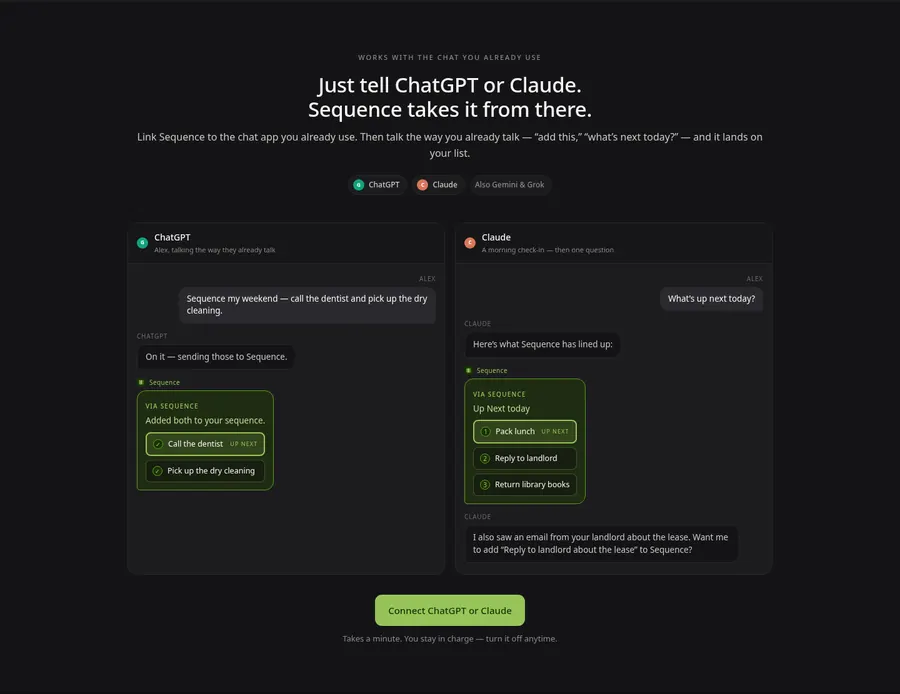
Is Sequence the right ADHD to-do app for you?
An honest fit check. Sequence is built for one next task, shared with a household, without overdue badges or streaks. Other tools are better at other jobs.
| If you want… | Good fit |
|---|---|
| One next task, no overdue badges or streaks, shared with your household | Sequence |
| A household TV/wall view of what's next | Sequence |
| AI that breaks a big task into small steps | A task-breakdown tool such as Goblin Tools (use alongside any app) |
| A visual timeline of your day | A visual day planner such as Structured or Tiimo |
| Deep projects, filters, and a personal GTD system | A list manager such as Todoist (see /todoist-alternative-adhd) |
| A native App Store / Google Play app today, or you live outside the US/Canada | Sequence isn't a fit yet |
Sequence will not replace a tool that breaks big tasks into tiny steps, or a visual day timeline, or a deep GTD system. It is for households that want one next task and a board the whole house can see.
Pricing
Sequence costs $6 per month or $59 per year per household. There is no per-person charge. New households get a 14-day free trial that does not need a credit card. Sequence is available in the United States and Canada.
Cancel in the app when you want. The trial does not convert unless you add a card and choose a plan.
Questions
What is the best to-do app for ADHD? +
How is Sequence different from a regular to-do list? +
Does Sequence use red overdue badges or streaks? +
Can my whole family use it? +
Does it handle recurring tasks? +
Does it work on iPhone and Android? +
How much does Sequence cost? +
Can ChatGPT or Claude add tasks to Sequence? +
Is Sequence a treatment for ADHD? +
Sequence is a household productivity tool. It is not medical advice, diagnosis, therapy, or a substitute for professional care.